

May 4, 2026
This weekend I went for a walk through the park near my house. It’s the first weekend of May, and for the first time this year, it truly smelled like spring again. The trees are turning green, the air is warming up, people are outside again, and suddenly you realize June is less than a month away.
Smells do that sometimes. They bring us back.
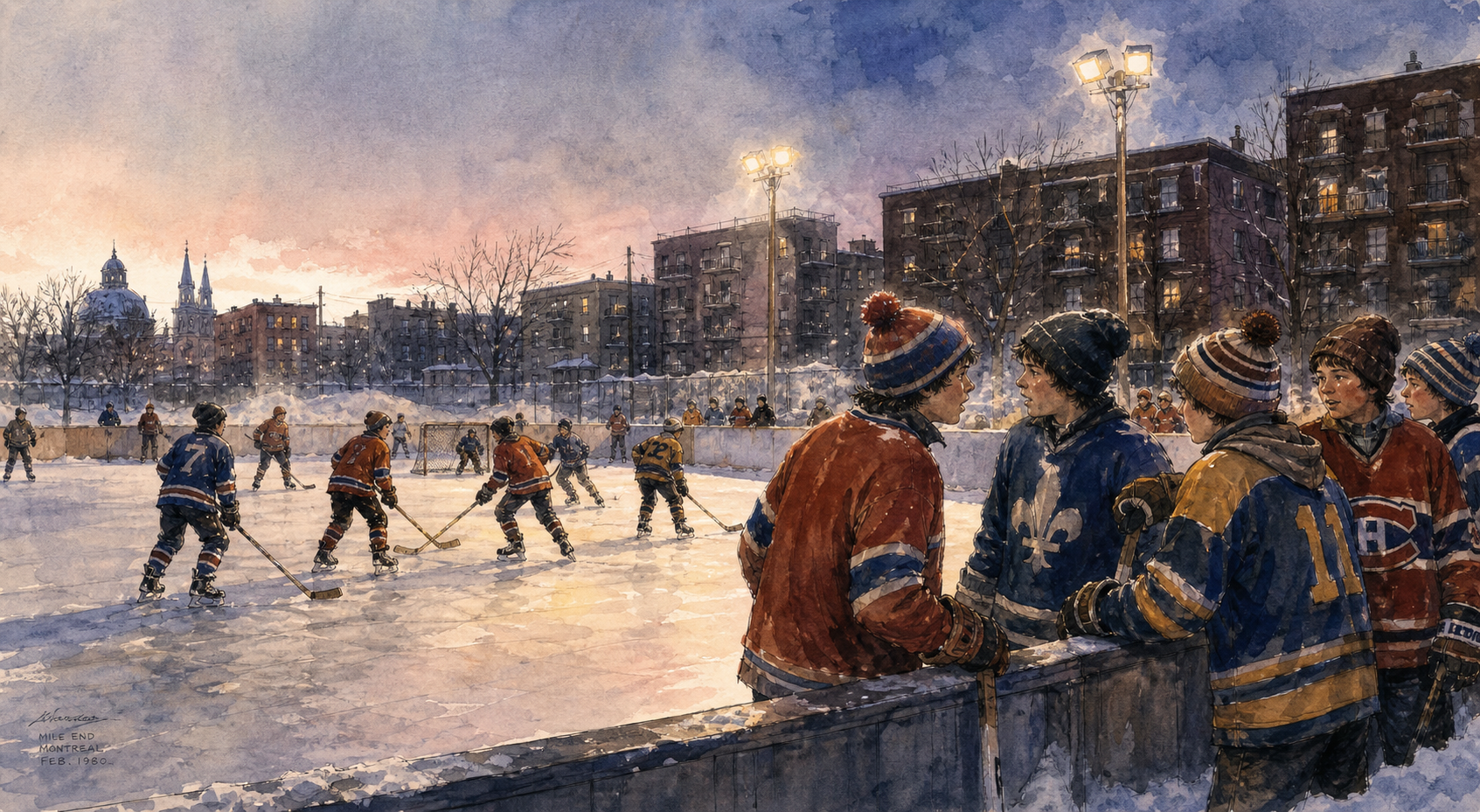
As I walked through the park, I found myself thinking about my childhood in Montreal. More specifically, I began thinking about the period surrounding the 1980 Quebec referendum. I was only eleven years old at the time, too young to fully understand the political complexities of what was happening, but old enough to sense that the country was moving through something important.
Even as children, we could feel it around us.
At Alexander Park, where we played hockey, there was always a rivalry between the English kids and the French kids. We argued, roughed each other up on the ice, and neither side particularly wanted to play on the same team as the other. Yet at the end of the day, we still played together. We still lived together. There was tension, certainly, but there was also coexistence. There were disagreements, but there remained a basic level of mutual recognition and respect.
Those memories stayed with me after my walk, and later that evening I decided to rewatch The Champions, the National Film Board documentary series examining the relationship between Pierre Trudeau and René Lévesque.
It could be argued that few political figures in Canadian history represented more fundamentally opposed visions of the country. One believed deeply in a united federal Canada. The other believed deeply in Quebec sovereignty. The stakes were enormous. National unity itself was openly being debated.
Yet despite those profound differences, there remained a level of mutual respect that feels increasingly uncommon in modern political life.
The disagreements were real. At times they became heated and deeply personal. But there was still an underlying understanding that political opponents were not enemies to be destroyed. They were participants in the same democratic system, attempting to move the country forward according to their own convictions and understanding of Canada.
Some of that appears to have been lost in modern political culture.
Too many disagreements now escalate into moral absolutes. Public discourse increasingly rewards outrage over understanding and conflict over resolution. Politics becomes less about persuading one another and more about defeating one another.
At the same time, I believe many Canadians are arguing about the wrong things entirely.
An enormous amount of national energy is now spent fighting over individual policies while far less attention is paid to the structural conditions producing so much frustration in the first place.
The growing sense of alienation visible in places like Alberta should be taken seriously. But I do not believe it exists solely because of one pipeline decision, one tax policy, or one particular government program. Governments change. Policies shift in one direction and then somewhat back again. The political pendulum moves, but usually within the same broader institutional framework.
The deeper issue appears increasingly structural rather than merely partisan.
More and more Canadians feel shut out of the democratic process itself. They feel unheard, underrepresented, and disconnected from how national decisions are made.
That points to a deeper systemic issue.
And systemic issues require systemic reforms.
That is why I believe Canada requires a serious national conversation about democratic modernization, electoral reform, representation, and national cohesion. Not because disagreement is unhealthy, but because healthy democracies require disagreement to function properly. Multiple voices at the table do not weaken democracy. In many respects, they strengthen it.
Parliament functions best when ideas are openly debated, challenged, refined, and improved through cooperation rather than imposed through artificial dominance. Different perspectives force governments to think more carefully, listen more broadly, and govern more responsibly.
Canada has always been a complicated country. It was never designed to function as a rigid ideological state. It survives through balance, accommodation, restraint, and an ongoing willingness to continue sharing the same national project despite our differences.
That may be one of the most important lessons worth remembering from that earlier era.
The issues were not fully resolved then, and some remain unresolved even now. Yet the country continued moving forward because democratic legitimacy, mutual respect, and cooperation remained stronger than division itself.
That is something worth preserving.
And perhaps, as Canada enters another complicated chapter in its history, it is also something worth relearning.